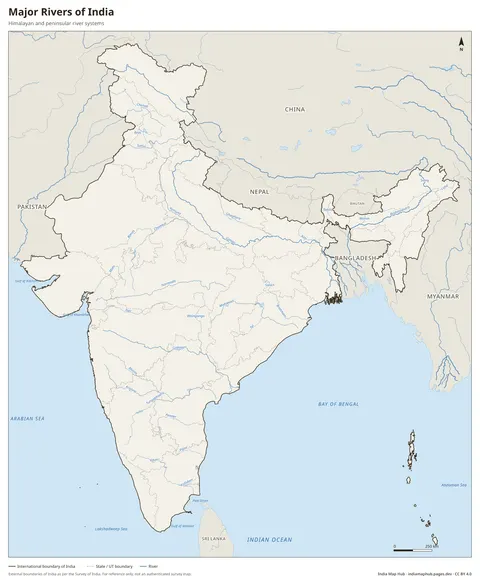
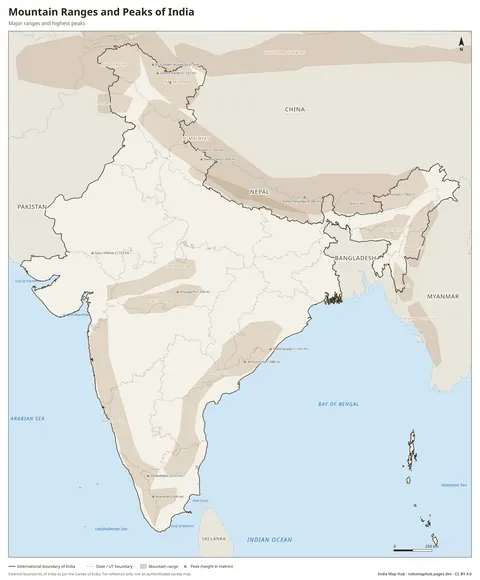
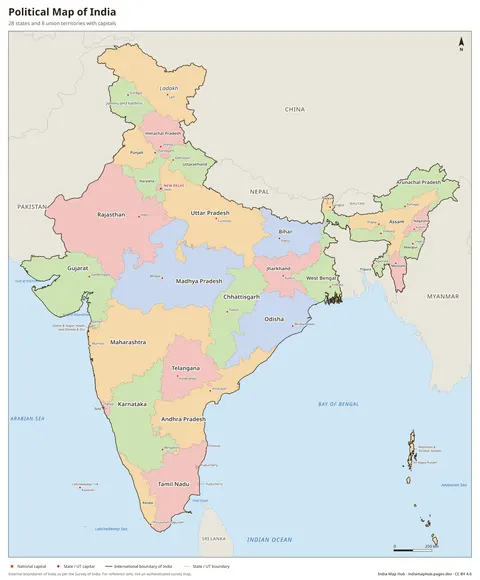
Physical Map of India
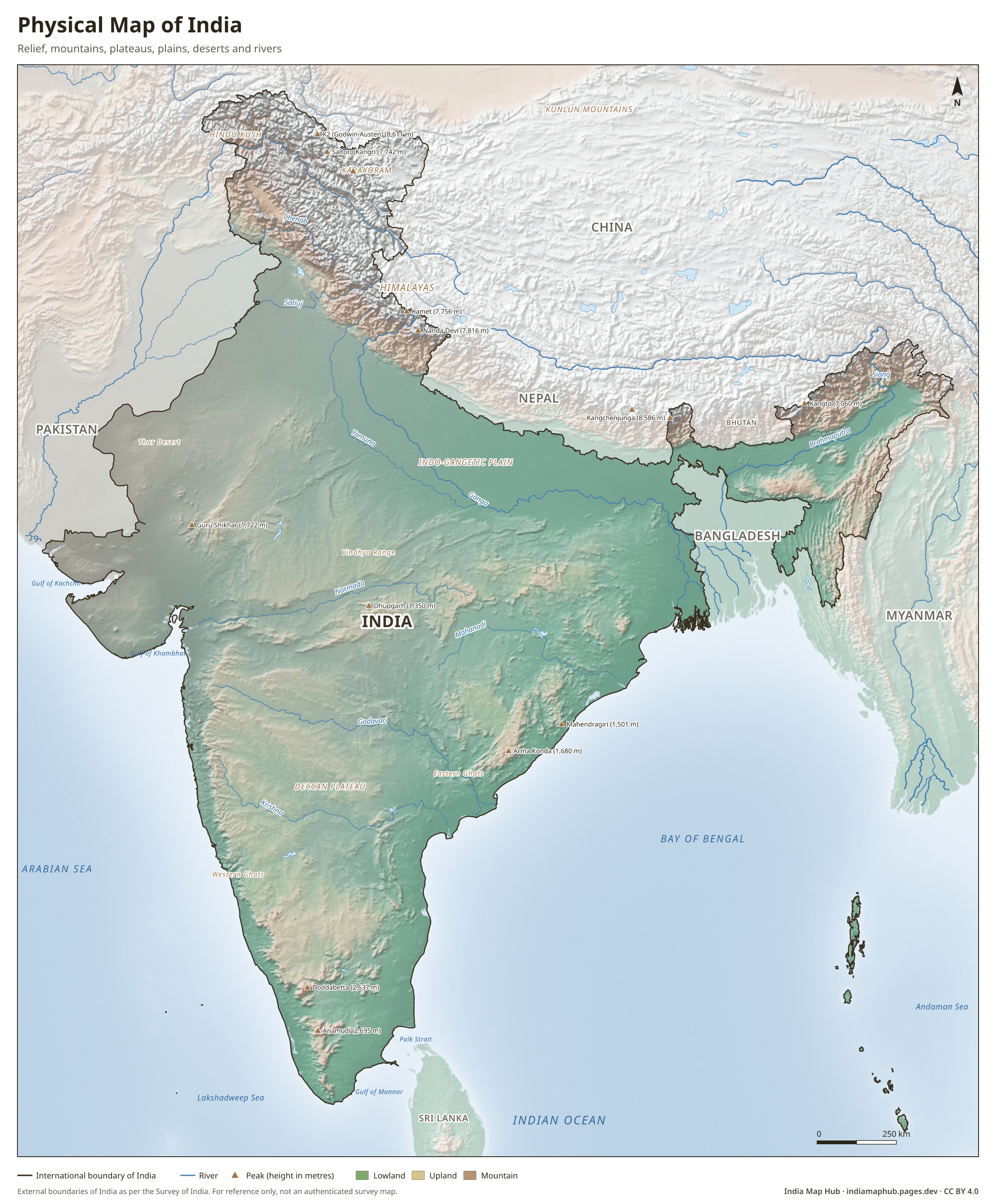
High-resolution physical map of India showing relief, the Himalayas, Western & Eastern Ghats, Deccan Plateau, Thar Desert, Indo-Gangetic Plain and major rivers. Free PNG & PDF.
About this map
The physical map of India shows how the land rises and falls. In the north are the Himalayas, then the vast Indo-Gangetic Plain, the Thar Desert in the west, the Deccan Plateau in the south, the Western and Eastern Ghats along the coasts, and the island groups of Lakshadweep and Andaman & Nicobar.
Geographers group India's physical features into six divisions: the Himalayan mountains, the Northern Plains, the Peninsular Plateau, the Indian Desert, the Coastal Plains and the Islands. K2 (Godwin-Austen, 8,611 m), in the Ladakh region as shown on the official map, is India's highest peak. Kangchenjunga (8,586 m), on the Sikkim–Nepal border, is the highest peak in the Indian-administered Himalaya.
Shading shows elevation: green for lowlands, tan and brown for uplands, and white for the highest snow-covered ranges.
How to use this map
- PNG: paste into Word, Google Docs, PowerPoint or Canva. Use the Print size for posters.
- PDF: print on A4 (or scale up to A3). It's a vector file, so it stays sharp.
- SVG: open in Illustrator, Inkscape, Figma or CorelDRAW to change colours, fonts or labels.
Boundaries on this map follow India's official boundary as published by the Survey of India. Read why this matters.
Credit line (copy & paste)
Required when you use this map. Keep it below the map, in your credits or in your references.
Embed on your website or blog
Frequently asked questions
What are the six physical divisions of India?
The Himalayan Mountains, the Northern Plains, the Peninsular Plateau, the Indian (Thar) Desert, the Coastal Plains and the Islands.
Which is the highest peak in India?
K2 (Mount Godwin-Austen, 8,611 m) according to India's official boundary. Kangchenjunga (8,586 m) is the highest peak in the Indian-administered Himalaya.
Which is the oldest mountain range in India?
The Aravalli Range in Rajasthan, Gujarat, Haryana and Delhi is one of the oldest fold mountain ranges in the world.